Gashka’oozo | Cluster
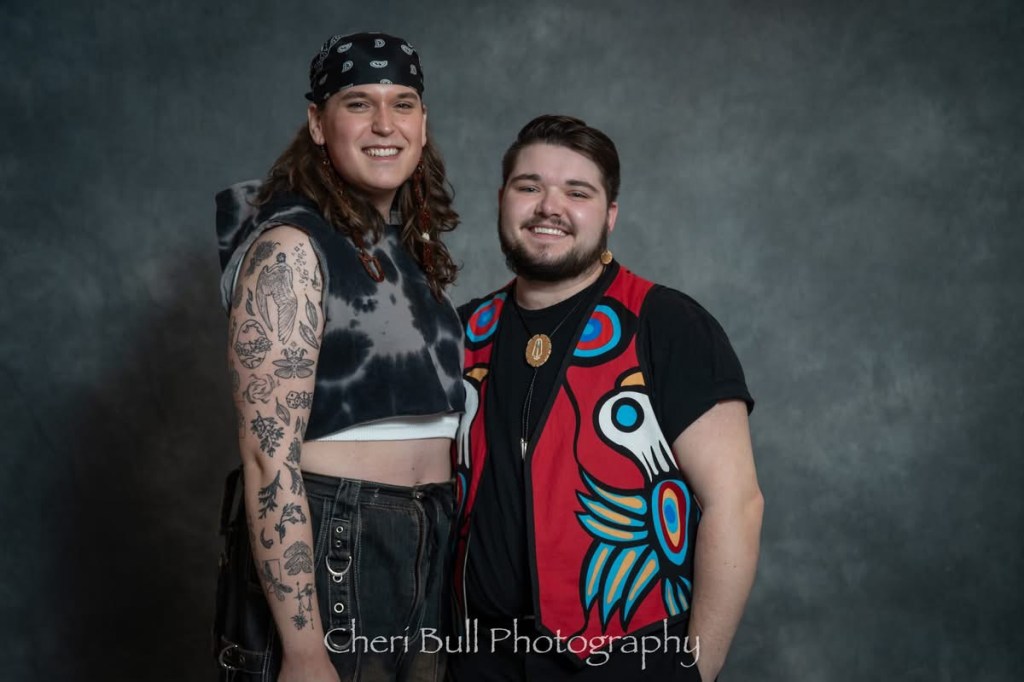
Sam & Connor
Sam and Connor explore identity while inviting the audience to reflect on their place in the world as “othered beings.” Through poetry, painting, and sewing, their performance highlights moments of assimilation and resistance
Sam et Connor explorent l’identité tout en invitant le public à réfléchir à sa place dans le monde en tant qu’êtres « autres » (othered beings). À travers la poésie, la peinture et la couture, leur performance met en lumière des instants d’assimilation et de résistance.
Sam Bénard-Barry
Sam Bénard-Barry (they/she/he) is an artist, academic, and activist based in N’Swakamok (Sudbury, ON). They have Indigenous (Algonquin from Maniwaki, Quebec), French, Finnish, and Irish roots. Sam completed a Bachelor’s degree in Social Work with a minor in Sociology at Laurentian University, where they are also completing a Master’s in Social Work. Sam is a visual artist, working as a muralist and bringing digital and acrylic artworks to life. Their most recognizable projects include Project Bird Strike, a series of murals on the windows of the Living with Lakes building, as well as a community mural in partnership with artist Raven Debassige (made possible through the support of Myths and Mirrors Community Arts and Cannabis and Mental Health), which highlighted the harm reduction work of funders.
Sam Bénard-Barry (iel/elle/lui) est artist.e, académique et activist.e à N’Swakamok (Sudbury, ON). Iel a des racines autochtones (Algonquin.e de Maniwaki, Québec), Françaises, Finlandaises et Irlandaises. Sam a complété un Baccalauréat en Service social et une mineure en Sociologie de l’Université Laurentienne, où iel complète également une Maîtrise en Service Social. Sam est artist.e visuel.le, travaillant comme muraliste, et donnant vie à des œuvres digitales et en acrylique. Ses projets les plus reconnaissables furent Project Bird Strike, une série de murales sur les fenêtres de l’édifice Living with Lakes, en plus qu’une murale communautaire en partenariat avec l’artiste Raven Debassige (rendu possible grâce au soutien de Myths and Mirrors Community Arts et Cannabis and Mental Health) qui soulignait le travail de réduction des méfaits des bailleurs de fonds.
Connor Lafortune
Connor Lafortune is from Dokis First Nation on Robinson Huron Treaty territory of 1850 in Northeastern Ontario. He works primarily in Life Promotion, harm-reduction, mental health, and Indigenous education. He completed his Bachelor’s Degree at Nipissing University with a Double Honors Major in Indigenous Studies and Gender Equality and Social Justice. He is currently in the Masters in Indigenous Relations at Laurentian University. Connor is Anishinaabek, Queer, and Francophone; he uses his understanding of the world to shape his creations as a writer, spoken word poet, and musician. Connor often combines the written word with traditional Indigenous beadwork and sewing to recreate the stories of colonization, showcase resilience, and imagine a new future. He recently released a single in collaboration with Juno Award winner G.R. Gritt titled “Qui crie au loup? ft. Connor Lafortune.” He is currently co-editing A Thousand Tiny Awakenings with Lindsay Mayhew through Latitude 46 Publishing. Above all else, Connor is an activist, a shkaabewis (helper), and a compassionate human being.
Connor Lafortune est originaire de la Première Nation de Dokis, dans le nord-est de l’Ontario. Il œuvre principalement dans les domaines de la promotion de la vie, de la réduction des méfaits, de la santé mentale et de l’éducation autochtone. Anishinaabek, queer et francophone, il met sa compréhension du monde au service de ses créations d’écrivain, de poète et de musicien. Connor allie l’écrit au perlage et à la couture traditionnels autochtones pour recréer les récits de la colonisation, mettre en valeur la résilience et imaginer un meilleur avenir. Il a sorti un single en collaboration avec G.R. Gritt, intitulé « Qui crie au loup? » en 2023. Cette année, il a également coédité A Thousand Tiny Awakenings avec Lindsay Mayhew, aux éditions Latitude 46.
 Fabulous Festival of Fringe Film