Redacting bodies Program
by Alexandra Gelis
If redaction is a way of editing documents, in which the removal of sensitive information is typically replaced
with black rectangles, aiming for its sanitization so that it can circulate within a broader audience, THEN this
removal of what we want missing, and cannot be shared, renders every image radically incomplete.
On occasion, the persons performing the redaction – the redactors – add brief elements of their own – covering and uncovering. The works in this program deal, in similar and different ways, with radical interrogations of
power, the body, the collective, the political and the land; inviting different kinds of sensibilities to this fundamental recognition, and re-representation of incompleteness. They are conceptual and visual invitations for each of us to enter in our way so that we can create new eco-logics.
Heather Frise and Mike Hoolboom, The Bed and the Street, 2018, 4:30 min Canada
A love story set in the global anti-austerity demonstrations. As citizens take back their streets, two women meet and fall in love. What geometry of desire will help overthrow the state? What micro-politics of sharing and communality will provide fuel for demonstrations that will remove and replace the neo-liberal consensus? Cast in a palimpsest of images and sounds, as if there were no way to separate inside and out, the street and the bedroom.
Rehab Nazzal, Bodies in Motion, 2017, 3:00 min Canada/Palestine
Bodies in Motion deals with bodies as sites of oppression as well as sites of resistance. The piece explores the logic of bodily movement, the gestural language of slinging stones at the occupation forces by Palestinian youth. It consists of hundreds of images of Palestinians protesters photographed in Palestine in 2015-2016 during regular protests against Israel’s colonial oppression. Converted into silhouettes, the images are punctuated with black and white photographs of individual protesters, connecting the real with the symbolic, the past with the present, and emphasizing the relation between individual
and collective bodies.
Kami Chisholm , Overpass, 2015, 5:00 min, USA/Canada
Beginning with a seeming ordinary afternoon drive down a Los Angeles highway, Overpass weaves together intimate stories of histories of racial and domestic violence against the backdrop of the infamous OJ Simpson car chase in 1994. In this lyrical, experimental short, filmmaker Kami Chisholm draws from television news reports, archival footage, and her own family history to explore the gaps between celebrity spectacle and the mundane realities of interpersonal violence endemic to US society.
Midi Onodera , Grief Without Fantasy (2012), 2017, 1:37 min
Filmmaker Midi Onodera approached writer Ronna Bloom to create short videos based on her poetry. Grief Without Fantasy is one of the results.
Sojin Chun, Treasure Hill Camouflage, 2016, 2:18 min
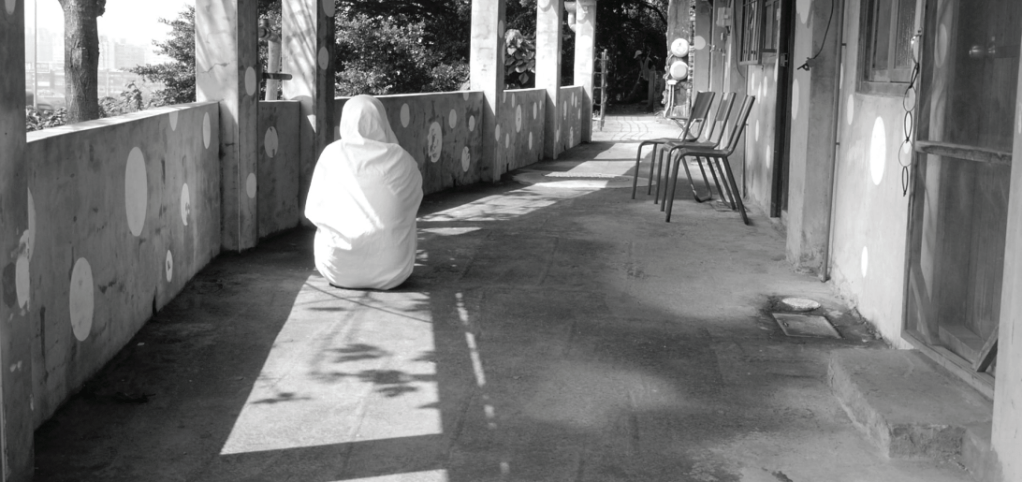
Treasure Hill Camouflage light-heartedly examines the notion of assimilation through performances for video while examining cultural and physical camouflage as a method of survival. In Taiwan, my natural Asian appearance deceives my “real” identity, allowing me to camouflage as Chinese or Taiwanese. Camouflaging is also a military technique and a method of survival, a tactic to blend into the landscape in order to stay alive.
Josephine Massarella, 165708, 2017, 6:37 min Canada
Shot entirely in 16mm black and white film using single frame photography, 165708 employs in-camera techniques and chemical manipulation of processed film to produce an eidetic study of temporal elasticity. Techniques include flicker, timelapse, light painting, stop motion, tinting, and toning. Combined with cycles of alternating exposed frames, these methods imbue the work with a rhythmic magnetism, apparent both in the tempo and the aesthetic of the images.
Exploring the capacity of the medium to express various notions of time, the film begins with a woman looking out from the shoreline. This acts as a point of departure to disparate yet interconnected sequences, which prompt the viewer to engage in a structurally unique mode of inquiry and experience. A dynamic original score by the acclaimed composer Graham Stewart accompanies the film.
Weibin Wang , Stroke, 2017, 5:18, Canada/China
Through a Skype call, the filmmaker investigates the cause of his grandfather’s illness. The film uses abstract imagery to capture the inner conflicts of a traditional Shanghainese home.
Thirza Cuthand, Thirza Cuthand is an Indian Within the Meaning of the Indian Act, 2017, 8:56, Canada
Contemplating mixed race identity in Canada, Cuthand presents us with images of blood ties and land ties for indigenous people, and questions the use of the words “white passing” and “light skinned.” As a light skinned indigenous woman, Cuthand reiterates that racism and discrimination still happen for her, just in different ways. Community belonging is contrasted with the difference experiences she has from her darker skinned family. Ultimately, a video with more questions than answers, it situates the artist’s body in historical trauma and ongoing colonial survival.
Julieta Maria, Limpia, 2013, 2:25 min Canada/Columbia
It means ‘to clean’, but in the Colombian Caribbean it also means to reprimand through spanking. Through this action, the video reveals the healing and authority role of a mother. Limpia has several meanings.
Jorge Lozano, Recreactions (From The House in Ruins 1 of 2), 2017, 5:00 min Canada/Columbia
Recreactions is a work about (re)inhabiting displacement. It is a response to the infrastructural dispositions that enable the uncovering of accidental force relations hidden within the folds of everyday encounters (abandoned spaces) with autobiographical memories.
Dan Browne, Generation, 2017, 2:00 min Canada
Generations explores the life cycles of a garden visit
Rebecca Garrett, search>site>scan>three sisters, 2003-2018, 20 min Canada
search>site>scan>three sisters is an evolving video performance that is the offshoot of a research and web based archiveand video project called search that was begun in 2003. Search explores the historical role and influence of colonial epistemologies and military on visual technologies and how these intervene in our relations to the land, our bodies and communities.
In the anthropocene, representation and survival are altered, engendering a radically transformed architecture of desire. The video frame cannot contain the generation of symbolic forms that are material, organic, inter-relational, and move out as performance into the actual space of possibility and reciprocity
 Fabulous Festival of Fringe Film