Flow
Program by Julie René de Cotret
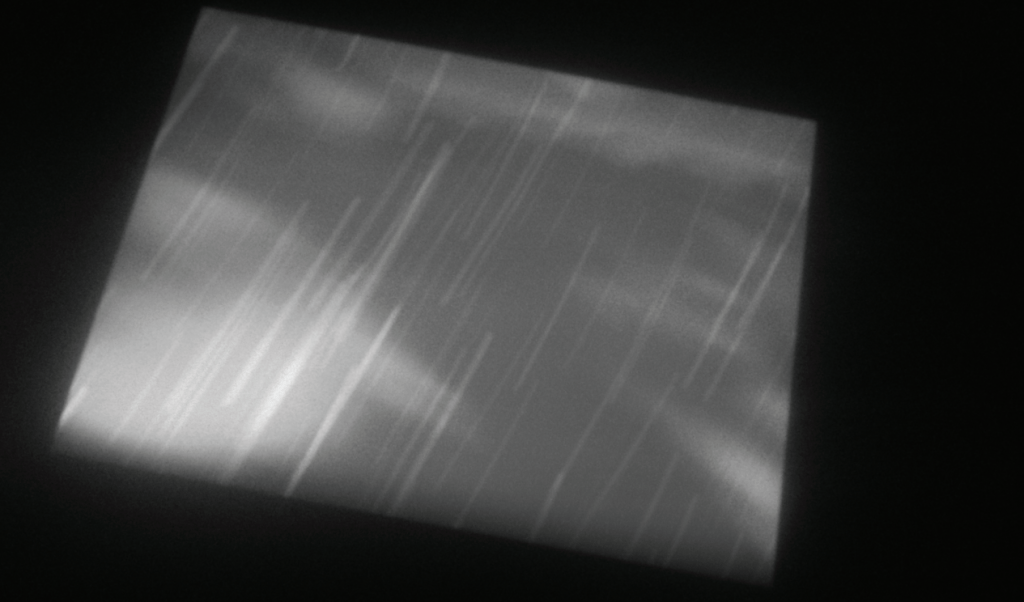
Jung-Chul Jung-Chul Hur & Julie René de Cotret, Bangkok Project, 2008
This image documents a collaboration between myself and artist Jung-Chul Hur. In the summer of 2008 we
projected live footage of the Bangkok sky onto the Grand River. We wanted to open a window. We wanted to
unite places, moments and all living sentient beings whether they drew breath from water or air. This program
aims to celebrate the same concept. My curatorial practice emerged out of a desire to unite works and collaborate with others to promote new visions of possible and essential change. As a child, I found the manner by which humans around me interacted with all living things to be cruel, biased, and illogical. Art is instrumental in creating space for questions that may bring the absurdity of certain human conventions to light and inspire change. This change must be motivated by love and respect for all living things, including earth. I want to thank the Saugeen Ojibway Nation for the opportunity to work, research and think on Saukiing Anishnaabekiig, their traditional territory. Research on the Saugeen river, revealed that 181 dams exist over its 198 km span. This surprising figure reminded me of museum collections, and how western systems of understanding are based on extraction, isolation and decontextualization. This approach justified use and control in the interests of immediate and unsustainable settler interests. I began to think about dividing air, the same way the entire ecosystem of the Saugeen River has been divided. We would instinctively know this approach would result in suffocation. Containment or isolation is contradictory to breathing. So what of air and water? They encompass the reciprocity of life on earth. Water and air are essential elements, breathed by all life. The restricting selective knowledge and individual interests that drive divisive, isolationist, and decontextualizing action, must be substituted for generosity, humility, curiosity and unity.
Patrick Bernachez. Chrysalide, 2008, 12:23 min
Part of a larger installation project and film trilogy, Chrysalide slowly pans a black BMW that is filling with water as it sits in an underground parking garage. A businessman sits at the wheel while the water level rises in the car.
Chris Myhr. Fathoms: The Weight of Smoke, 2018. 10:00 min
Fathoms: The Weight of Smoke is part of a body of work entitled Point-Line-Intersection, which examines the interrelationships between culture and natural water systems. The 10-minute audio-visual composition features high definition video of
debris clouds hovering above the Atlantic seafloor and abstracted motion-graphic animations of selected marine artefacts. The sound is comprised of ambient recordings from the spaces within various containers recovered from these underwater sites like ceramic vessels, bottles, and artillery shells.
soft turns. EMATERIAL, 2019, 10:10 min
The series EMATERIAL explores the material embodiment of the digital by showing the submersion and dissolution of inkjet photographs depicting discarded, burning e-waste. These images capture the unsafe handling of electronic waste, a toxic scavenging industry exported to the world’s most vulnerable communities. In these videos, the water currents that pull the ink from the page like plumes of toxic smoke seem to embody the act of erasure. Yet the image does not fully disappear, in fact, this action brings forth a strangely animated performance of materials, suggesting the impossibility of full erasure. Matter never vanishes, it only changes its state, even in a virtual context.
Jenn E. Norton. The Weeping Brook, 2019, 2:30 min
The Weeping Brook explores the movement of a river’s current as it gently sweeps the tendrils of submerged plants. In the undulating greenery and flittering silt emerges a body that has long been at rest, covered in the growth of algae and seagrass. The Weeping Brook draws upon the sorrow of Ophelia, who turned to the river in despair of human cruelty and ruminates on the origins of her name from the Greek word, (ophelos), meaning “help”.
Amanda Strong. How to Steal a Canoe, 2016, 4:10 min
How to Steal a Canoe tells the story of a young Nishnaabeg woman and an old Nishnaabeg man rescuing a canoe from a museum and returning it to the lake where it was meant to be. It is a story about reclaiming the precious parts of us, whichwere always ours in the first place. With lyrics and narration by Nishnaabeg poet Leanne Betasamosake Simpson and an original score by Cree cellist Cris Derksen.
Caroline Monnet. Mobilize, 2015, 3:32 min
Guided expertly by those who live on the land and driven by the pulse of the natural world, Mobilize takes us on an exhilarating journey from the far north to the urban south. Over every landscape, in all conditions, everyday life flows with strength, skill and extreme competence. Hands swiftly thread sinew through snowshoes. Axes expertly peel birch bark to make a canoe. A master paddler navigates icy white waters. In the city, Mohawk ironworkers stroll across steel girders, almost touching the sky, and a young woman asserts her place among the towers. The fearless polar punk rhythms of Tanya Tagaq’s Uja underscore the perpetual negotiation between the modern and traditional by a people always moving forward.
Mobilize is part of Souvenir, a four-film series commissioned by the National Film Board of Canada to address Aboriginal identity and representation by reworking material in the NFB’s archives.
Tasman Richardson. Darkness is to space as silence is to sound, 2018, 16 min
(Conceived for live performance, this work was modified for the Hannover drive-in)
By coupling satellite video surveillance and radio frequency applications, Tasman Richardson programs geographical glimpses and their specific sonorities, into a three-channel piece. Views depict human population density concentrated along shorelines and the tremendous human devastation of the planet.
 Fabulous Festival of Fringe Film